
How to Create an Effective SEO Strategy for a New Website
How to Create an Effective SEO Strategy for a New Website is an important question for anyone launching a new website and looking to build a strong online presence. Creating a website is only the first step. Once the site is launched, the next challenge is making sure the right people can discover it through search engines.
A beautifully designed website may have limited value if potential customers cannot find it when searching online. This is where Search Engine Optimization, or SEO, becomes important. SEO helps search engines understand your website and helps users discover pages that are relevant to their searches.
When planned properly, SEO can become a long-term source of organic traffic, enquiries, leads, and customers. A well-structured SEO strategy helps a new website build visibility, reach the right audience, and gradually improve its position in search results.
For a new website, SEO should begin as early as possible. Waiting until the website has been online for several months can mean missing opportunities to build a strong search presence from the beginning.
In this guide, we will look at a practical approach to creating an SEO strategy for a newly launched website.
What Does an SEO Strategy Actually Mean?
An SEO strategy is a roadmap for improving a website’s presence in organic search results.
It combines several activities, including understanding your audience, selecting appropriate search terms, developing useful content, improving website structure, fixing technical issues, earning relevant links, and measuring results.
Think of SEO as building a digital foundation. Your website is the building, your content is what makes it useful, and technical optimization helps search engines access and understand everything properly.
A good SEO strategy does not focus on one activity alone. Different parts of SEO need to work together.
Start by Defining Your Website’s Main Goal
Before doing keyword research, decide what you want your website to achieve.
Different websites have different objectives. A business website may want enquiries, an online store may want product sales, while a blog may focus on attracting readers.
Ask yourself:
- What is the main purpose of my website?
- Who do I want to reach?
- What action should visitors take?
- Which products or services are most important?
- Which locations do I serve?
- What makes my business different?
For example, suppose you own a furniture business. Your website might aim to generate enquiries for living room sets, bedroom furniture, dining tables, and custom furniture.
Once your goal is clear, it becomes much easier to decide which pages and keywords deserve the most attention.
Understand What Your Potential Customers Search For
SEO begins with the customer, not the search engine.
Try to understand the questions, problems, and needs of your target audience.
Imagine someone is planning to buy a new sofa. They may search for:
- Best sofa for a small living room
- Modern sofa designs
- Comfortable sofa for home
- Premium living room furniture
- Sofa shop near me
These searches reveal different stages of the customer’s decision-making process.
Some people are researching. Others are comparing choices. Some are ready to make a purchase.
Understanding these differences allows you to create content for each stage.
Research Keywords Before Creating Pages
Keyword research helps you discover the terms people use when looking for information, products, or services.
Do not select keywords simply because they have high search volume. A keyword should also be relevant to your website and capable of attracting the right audience.
For example, a digital marketing freelancer may consider keywords such as:
- SEO services for small businesses
- Freelance digital marketing expert
- Local SEO services
- Google Ads specialist
- Social media marketing services
A new website may find it challenging to compete immediately for extremely broad terms. More specific search phrases can sometimes provide a better starting point.
Consider Long-Tail Searches
Long-tail keywords are usually more detailed search phrases.
For example:
General: SEO services
Specific: SEO services for small businesses in Kerala
The second phrase is more specific and may better match a particular customer’s needs.
The important point is not to use as many keywords as possible. Instead, select search terms that genuinely represent what your website provides.
Match Content With Search Intent
Knowing a keyword is not enough. You also need to understand why someone is searching for it.
This is known as search intent.
For example:
“What is technical SEO?”
This person is probably looking for an explanation.
“Best SEO tools for beginners”
This person may be comparing different tools.
“SEO consultant near me”
This person may be searching for a service provider.
If you understand the intent behind a search, you can create a page that answers the user’s actual need.
This can make your content more useful and improve the overall search experience.
Build a Logical Website Architecture
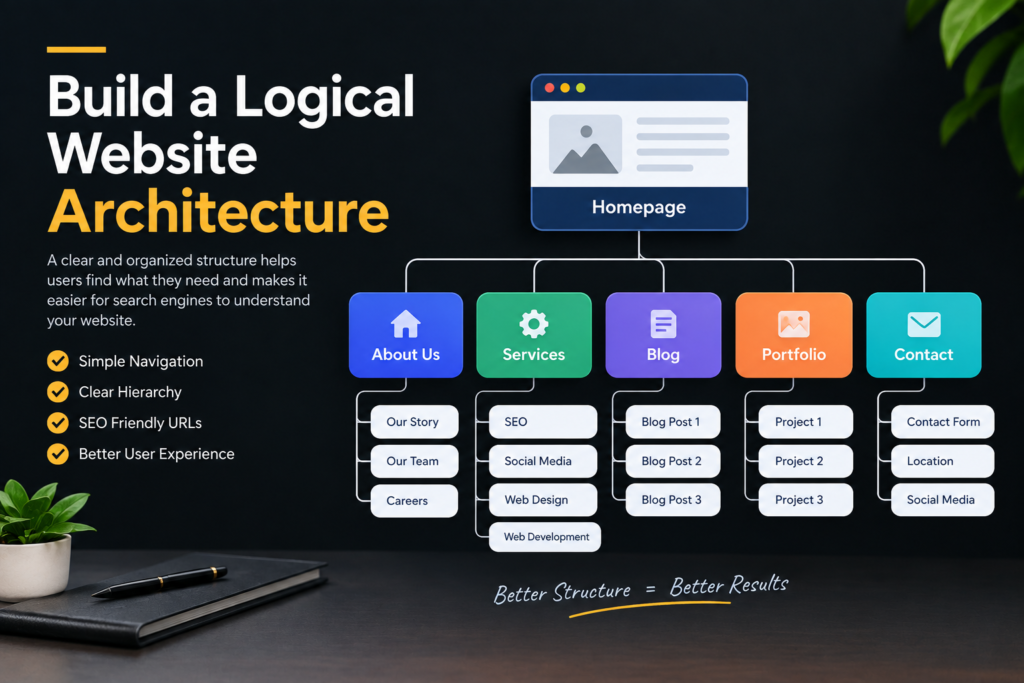
A new website should have a clear structure before you start publishing large amounts of content.
Visitors should be able to move from one section to another without confusion.
For example, a digital marketing website might have:
Home
→ About
→ Services
→ SEO
→ Google Ads
→ Social Media Marketing
→ Web Design
→ Blog
→ Contact
Each major service can have its own dedicated page.
This approach allows you to explain each service in greater detail and gives search engines clearer information about the subjects covered by your website.
Give Every Important Page a Clear Purpose
Avoid creating pages simply because you want to add more URLs to your website.
Every important page should answer a particular question or fulfill a specific purpose.
For example:
- Homepage → Introduces your business
- About page → Explains who you are
- Service page → Describes what you offer
- Blog post → Provides useful information
- Contact page → Helps users get in touch
When each page has a clear role, your website becomes easier to navigate and easier to optimize.
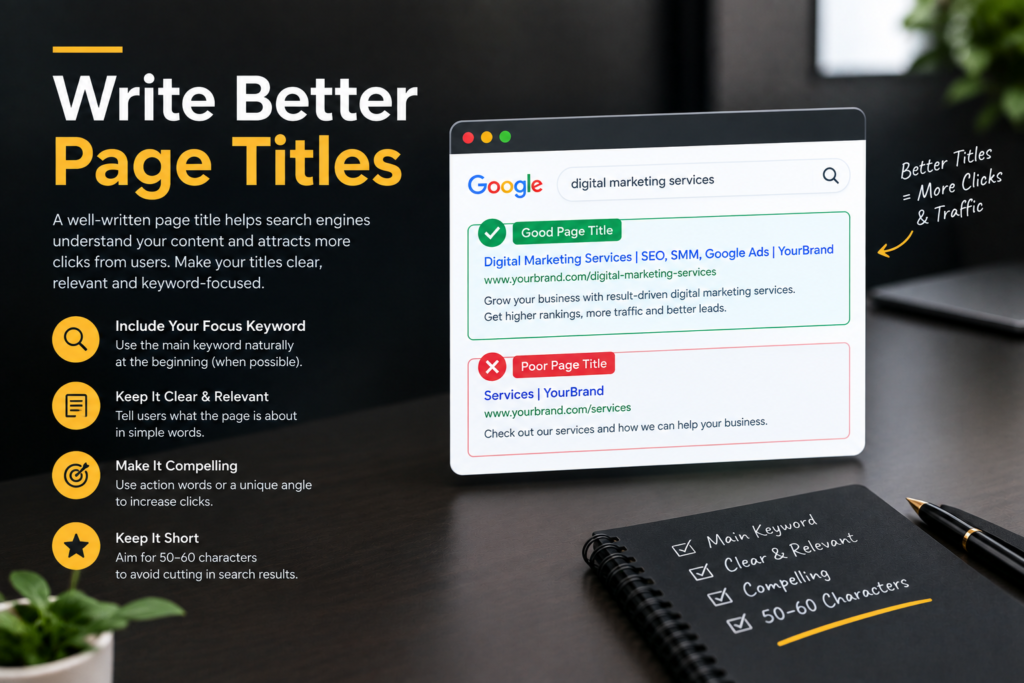
Write Better Page Titles
The title of a webpage gives both users and search engines an initial idea about its subject.
Instead of using generic titles such as:
Services
you could use:
Digital Marketing Services for Growing Businesses
A useful title should accurately represent the page.
Avoid trying to include several unrelated keywords in one title. A clear and relevant title is usually more helpful than a title packed with search terms.
Create Helpful Meta Descriptions
A meta description summarizes what a page is about.
Although it is not simply a place to repeat keywords, it can help communicate why someone should visit your page from search results.
For example:
“Discover practical digital marketing solutions designed to improve online visibility, reach potential customers, and support business growth.”
Write descriptions that accurately represent the page and encourage the right audience to explore further.
Organize Content With Headings
Large blocks of text can be difficult to read.
Break your content into logical sections using headings and subheadings.
For example:
H1
How to Create an Effective SEO Strategy
H2
What Is SEO?
H2
Why SEO Matters for New Websites
H2
How to Research Keywords
H3
Finding Long-Tail Keywords
This structure makes your article easier to scan and helps readers quickly find the information they need.
Publish Content That Solves Real Problems
One of the strongest ways to grow a new website is to consistently publish useful content.
Instead of asking, “How many keywords should I put in this article?”, ask:
“What information would actually help my reader?”
If your website offers SEO services, you could create articles covering:
- SEO basics
- Keyword research
- Local SEO
- Technical SEO
- Internal linking
- Website speed
- SEO mistakes
- Google Search Console
- Content optimization
Each article can address a different question while supporting your broader business topic.
Avoid Writing Only for Search Engines
A common mistake is producing content that sounds unnatural because it has been written mainly around keywords.
For example, repeating the same phrase several times in every paragraph does not automatically make an article better.
Instead:
- Use natural language
- Explain concepts clearly
- Add practical examples
- Answer related questions
- Keep paragraphs readable
- Remove unnecessary repetition
Your content should sound like it was written for a person first.
Strengthen On-Page SEO
On-page SEO involves improving elements within your own website.
Some areas worth reviewing include:
- Page titles
- Headings
- Main content
- URLs
- Images
- Internal links
- Meta descriptions
- Content organization
Make sure each page has a clear topic and that the important information is easy for visitors to find.
Pay Attention to Technical SEO
A website can have excellent content and still face SEO problems if search engines cannot properly access or understand it.
Technical SEO covers the underlying structure and performance of the website.
Important areas include:
Website Loading Speed
Large images, unnecessary plugins, excessive scripts, and poor hosting can affect page performance.
Optimize your website so visitors do not have to wait unnecessarily for pages to load.
Mobile Experience
Your website should function properly on smartphones and tablets.
Check whether:
- Text is easy to read
- Buttons are easy to tap
- Menus work correctly
- Images fit the screen
- Forms are usable
- Content does not overflow horizontally
Secure Connection
Use HTTPS to provide a secure connection between your website and its visitors.
Crawlability
Search engines need to be able to access important pages.
Review your website’s technical configuration to make sure valuable content is not accidentally blocked.
Create and Submit an XML Sitemap
An XML sitemap provides search engines with information about the pages you want them to discover.
For a new website, creating a sitemap and submitting it through Google Search Console is a useful part of the setup process.
However, a sitemap does not guarantee rankings. Its main purpose is to help search engines discover and understand the structure of your website.
Use Robots.txt Carefully
The robots.txt file can provide instructions to search engine crawlers about areas they should not access.
This file needs to be configured carefully.
A small mistake can prevent search engines from accessing important sections of a website.
Before making changes, understand exactly which pages or resources you are allowing or restricting.
Connect Google Search Console
Google Search Console is particularly useful for a newly launched website.
It can provide information about how your pages are appearing in Google Search.
You can use it to review:
- Search impressions
- Clicks
- Search queries
- Average search position
- Indexing status
- Sitemap information
- Technical issues
Instead of guessing how your website is performing, use the available data to identify areas that need improvement.
Build Strong Internal Connections
Internal linking means connecting relevant pages within your own website.
Suppose you publish an article called “How to Improve Local SEO.” You could naturally link from that article to your local SEO service page.
This gives readers a clear path to additional information.
It can also help search engines understand which pages on your website are related to one another.
Do not add internal links randomly. Place them where they genuinely help the reader.
Make Images Search-Friendly
Images can improve the appearance and usefulness of your website, but they should also be optimized.
Before uploading an image:
- Resize it appropriately
- Compress the file
- Use a suitable format
- Give it a meaningful filename
- Add descriptive alt text when appropriate
For example, a filename such as:
modern-bedroom-furniture.jpg
provides more context than:
image001.jpg
Alt text should describe the image accurately rather than being filled with repeated keywords.
Develop a Natural Backlink Strategy
Backlinks are links from external websites pointing toward your website.
They can help establish your website’s authority when they come from relevant and trustworthy sources.
For a new website, focus on earning meaningful links rather than collecting as many links as possible.
Possible approaches include:
- Publishing original research
- Creating useful guides
- Contributing expert articles
- Getting listed in relevant business directories
- Building relationships with local organizations
- Creating resources other websites want to reference
Quality and relevance should be the priority.
Don’t Depend on Spammy Link-Building Methods
Some websites try to increase rankings by creating hundreds of low-quality links.
This is not a reliable long-term SEO strategy.
Avoid tactics that involve irrelevant link farms, automated spam, or manipulative link schemes.
Instead, concentrate on creating something valuable enough that relevant websites have a genuine reason to mention or reference it.
Give Local SEO Attention to Local Businesses
If your business serves customers in a particular area, local SEO should be part of your strategy.
For example, a local business could optimize its online presence around relevant products or services and the locations it genuinely serves.
Important activities can include:
- Maintaining an accurate Google Business Profile
- Keeping business details consistent
- Collecting genuine customer reviews
- Creating useful local content
- Building relevant local citations
- Mentioning service areas naturally
Do not create dozens of nearly identical location pages just to target different places. Local content should provide real value.
Create a Realistic Content Calendar
You do not need to publish a new article every day.
Consistency is more important than volume.
A simple monthly plan could look like this:
Article 1: SEO basics for beginners
Article 2: Keyword research guide
Article 3: Local SEO strategies
Article 4: Common technical SEO problems
You can also revisit older articles and improve them when you have new information, better examples, or additional insights.
Over time, this can create a useful collection of content around your main business topics.
Measure More Than Keyword Rankings
Keyword rankings are useful, but they are not the only measure of SEO success.
A website can rank for keywords and still fail to generate meaningful business results.
Monitor metrics such as:
- Organic visitors
- Search impressions
- Click-through rate
- Leads
- Enquiries
- Sales
- Indexed pages
- Engagement
- Conversions
The most valuable SEO traffic is traffic that is relevant to your business and has the potential to become a customer.
Review and Improve Your Strategy
SEO is not something you complete once and forget.
Search behavior changes. Competitors publish new content. Websites develop technical issues. Some pages become outdated.
Review your website regularly.
Look for:
- Pages receiving little traffic
- Content that needs updating
- Broken links
- Technical problems
- New keyword opportunities
- Pages with high impressions but low clicks
- Content that could be expanded
Use the data you collect to decide what to improve next.
SEO Mistakes New Websites Should Avoid
A new website can lose valuable opportunities by making simple mistakes.
Targeting Extremely Broad Keywords
Trying to rank immediately for highly competitive terms may not be realistic.
Creating Duplicate Pages
Publishing multiple pages with nearly identical content can make your website unnecessarily complicated.
Ignoring Search Intent
A page may contain the right keyword but still fail to satisfy what the searcher actually wants.
Overusing Keywords
Natural writing is better than repetitive keyword placement.
Forgetting Internal Links
Important pages should not be isolated from the rest of the website.
Neglecting Mobile Optimization
A website that looks good only on a desktop computer is not enough.
Expecting Immediate Results
SEO generally requires patience and continuous work.
A Practical SEO Roadmap for a New Website
Here is a simple way to organize your SEO work.
Phase 1: Preparation
- Define your business goals
- Identify your audience
- Research competitors
- Find relevant keywords
- Plan your website structure
Phase 2: Website Optimization
- Create important pages
- Improve titles and headings
- Optimize URLs
- Add useful content
- Compress images
- Improve mobile usability
Phase 3: Technical Setup
- Enable HTTPS
- Create an XML sitemap
- Review robots.txt
- Connect Google Search Console
- Check indexing
- Improve website performance
Phase 4: Content Growth
- Publish useful blog posts
- Answer customer questions
- Build topic clusters
- Add internal links
- Update existing content
Phase 5: Authority Building
- Earn relevant backlinks
- Build local citations
- Promote useful resources
- Develop relationships within your industry
Phase 6: Measurement
- Track search performance
- Monitor organic traffic
- Review conversions
- Find weak pages
- Improve content based on data
New Website SEO Checklist
Before considering your initial SEO setup complete, review this checklist:
☐ Define your website objective
☐ Identify your ideal audience
☐ Research relevant search terms
☐ Understand search intent
☐ Plan your website architecture
☐ Create dedicated pages for important services
☐ Write useful original content
☐ Optimize page titles
☐ Improve meta descriptions
☐ Structure headings correctly
☐ Create descriptive URLs
☐ Add relevant internal links
☐ Optimize images
☐ Check mobile usability
☐ Improve page speed
☐ Enable HTTPS
☐ Create an XML sitemap
☐ Review robots.txt
☐ Set up Google Search Console
☐ Work on local SEO when relevant
☐ Earn relevant backlinks
☐ Track important SEO metrics
☐ Update content regularly
Conclusion
Launching a website is only the beginning of your online journey. To attract organic visitors, you need a clear plan for helping search engines understand your website and helping users find useful information.
A successful SEO strategy starts with understanding your audience. From there, you can research meaningful keywords, organize your website properly, create helpful content, strengthen on-page elements, improve technical performance, develop internal links, and build genuine authority.
Do not focus only on achieving a high position in search results. Think about the complete journey—from the moment someone searches for a solution to the moment they visit your website and decide to contact, purchase, or engage with your business.
SEO takes time, especially when a website is new. There may not be dramatic results in the beginning, but every well-optimized page, useful article, technical improvement, and relevant connection contributes to a stronger foundation.
The best SEO strategy is not about doing everything at once. It is about making the right improvements consistently and using real performance data to decide what to do next.
Build for your audience, optimize for search, measure your progress, and keep improving. That is the foundation of long-term SEO success.