
How to Find the Right SEO Keywords for Your Website
Introduction
Imagine launching a website for your business, publishing helpful articles, and waiting for visitors to arrive. Weeks pass, but your website receives very little traffic. One possible reason is that your content does not match the words people use when searching online.
Learning how to find the right SEO keywords can help you understand what your target audience is looking for and create content that better matches their needs. By researching relevant search terms, analyzing search intent, and choosing suitable keywords, you can improve your website’s chances of appearing in relevant search results and attracting the right visitors.
This is where keyword research becomes valuable. Learning How to Find the Right SEO Keywords helps website owners discover the language their potential customers use when looking for information, solutions, and services.
Selecting suitable keywords is not about adding popular words to every page. It involves understanding your audience, discovering their interests, and choosing topics that your website can answer effectively.
Whether you manage a business website, write blogs, or work as a digital marketer, understanding How to Find the Right SEO Keywords can help you make better content decisions and improve your website’s chances of attracting relevant organic traffic.
This article explains a practical approach to keyword research, from understanding customer needs to selecting the right keywords and measuring their performance.
Understanding the Connection Between Keywords and Website Content

People rarely search online using the same words that businesses use to describe their services. A company might advertise its expertise in website optimization, while a customer searches for ways to make a website load faster.
Both phrases relate to the same subject, but they reflect different ways of expressing a need.
Keyword research helps you identify these differences. It allows you to create pages that connect your knowledge with the questions your audience wants answered.
For example, a person learning about online marketing might search for beginner tutorials. A business owner experiencing poor website traffic might look for an SEO consultant. Although both searches relate to digital marketing, each requires a different type of content.
Understanding these differences is the foundation of effective keyword selection.
1. Begin With Your Customers’ Problems
Instead of immediately opening a keyword tool, start by thinking about the people who may visit your website.
Consider the questions they ask, the challenges they experience, and the information they need before making a decision.
If you provide digital marketing services, your potential customers might want to know why their websites receive few enquiries, how to promote a new business, or how to attract customers through Google.
Turn these problems into possible content topics.
For instance:
- Why is my website not getting visitors?
- How can a small business attract customers online?
- What should I know before hiring an SEO professional?
- How can I improve my website’s Google visibility?
- Which digital marketing services does my business need?
These questions provide useful starting points for discovering keywords. They also help you develop content that answers genuine customer concerns rather than publishing articles without a clear purpose.
2. Explore the Language People Use in Search
Your first keyword ideas may be too broad. To discover more specific phrases, examine how people describe the topic in their own words.
Google can provide useful clues through its autocomplete suggestions, related searches, and question-based results.
Suppose you are researching website speed. You could begin with the phrase “website loading” and investigate related searches such as:
- Why does my website load slowly?
- How can I test website speed?
- What affects website loading time?
- How can I reduce image file sizes?
These phrases reveal different questions surrounding one subject.
You can also explore relevant discussions in online communities, customer enquiries, and frequently asked questions. These sources may reveal useful content ideas that are not obvious from a basic keyword list.
Treat these suggestions as research ideas rather than proof of search demand. Use keyword tools when you need estimated search volume or competition data.
3. Build a Keyword Collection for Each Topic
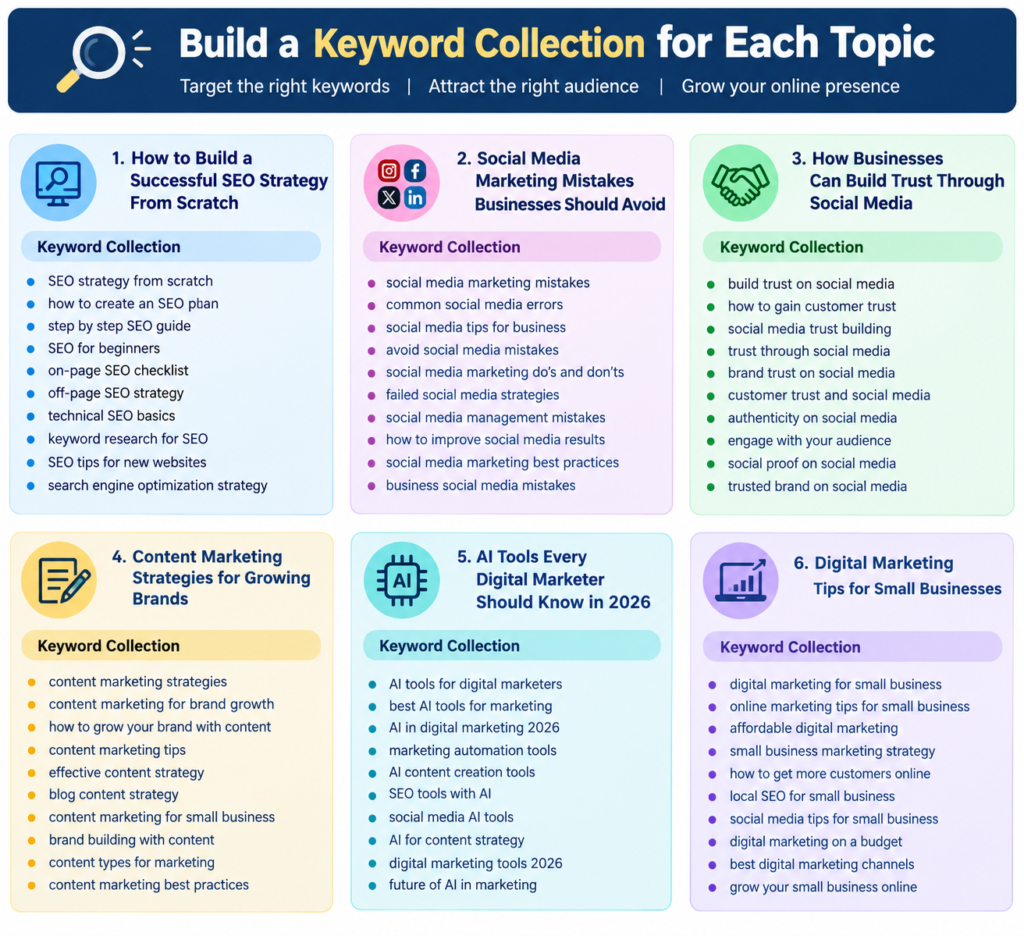
Once you have gathered some ideas, organize them into related groups.
A keyword collection should contain phrases that belong to the same subject. This makes it easier to plan articles and decide which pages deserve individual attention.
For example, a website covering search engine optimization could organize its research like this:
Keyword research: finding search terms, keyword planning, keyword analysis.
Website optimization: page titles, internal linking, image optimization, website structure.
Local visibility: local search optimization, Google Business Profile, location-based searches.
SEO measurement: organic traffic, search impressions, ranking reports, website performance.
Grouping keywords in this way helps you identify connections between topics. It can also prevent your blog from becoming a collection of unrelated articles.
When several keywords express the same underlying need, one comprehensive article may answer them all. Create separate pages when the search purpose or information required is meaningfully different.
4. Learn What Searchers Expect to Find
A keyword becomes more useful when you understand the type of result a person expects.
Consider the difference between “SEO meaning” and “SEO agency pricing.” The first search suggests a need for an explanation. The second suggests that the user wants information about the cost of professional services.
Before choosing a keyword, search for it and examine the results.
Look at the formats Google displays, the subjects covered by leading pages, and the questions those pages answer. Notice whether the results mainly contain tutorials, service pages, comparison articles, or product listings.
This process helps you decide what kind of content to create.
If users are looking for a practical tutorial, a short promotional page may not satisfy their needs. If they are comparing service providers, a general educational article may not be the best destination.
Matching the content format to the search purpose gives your page a clearer direction.
5. Find Keyword Opportunities With Research Tools
Keyword research tools can help you expand your ideas and assess their potential.
Google Keyword Planner provides keyword suggestions and estimated search data. Google Trends allows you to compare interest in different topics over time. Google Search Console reveals queries for which your existing website appears in search results.
Third-party platforms such as Semrush, Ahrefs, and Ubersuggest may provide additional information about keyword difficulty, related phrases, and competing pages.
You do not need to use every available tool. Choose resources that answer your specific research questions.
For example, if you already have a website, Search Console can help you discover search queries that generate impressions. If you are planning a new blog, a keyword research tool may help you compare potential topics before writing.
Remember that search volume and difficulty figures are estimates. They should guide your decisions, not determine them automatically.
6. Evaluate the Value of Each Keyword
A useful keyword should have a clear connection to your website and its intended audience.
Before selecting a phrase, consider four important questions:
Relevance: Does the topic match your expertise, services, or website purpose?
Demand: Is there evidence that people search for this subject?
Competition: Can you produce a useful page that competes with the existing results?
Business value: Could the people searching for this phrase benefit from what your website offers?
Imagine that you manage a website offering SEO services. A broad topic about the history of the internet may attract readers, but it might not be closely connected to your services. An article explaining how local businesses can improve their online visibility may be more relevant to your intended audience.
A keyword with a smaller audience can still be valuable when it attracts the right visitors.
7. Investigate the Competition Before Writing
Keyword research should include a review of the pages already appearing in search results.
Choose a potential keyword and examine several relevant results. Look at the depth of their explanations, the questions they answer, the examples they provide, and any important information they leave out.
Your aim is to identify opportunities to create something genuinely useful.
Perhaps existing articles explain keyword research but do not show readers how to organize their findings. You could address that gap with a practical keyword planning example.
Alternatively, you might explain technical terms in simpler language or provide a clearer step-by-step process.
Do not reproduce a competitor’s wording or simply rearrange its paragraphs. Develop your own explanation, use relevant examples, and make sure your content reflects your own understanding of the subject.
A meaningful improvement in usefulness is more valuable than superficial rewriting.
8. Select the Main Keyword for Your Article
After reviewing your keyword collection, choose one primary phrase that clearly represents the article’s central purpose.
For a blog explaining keyword selection, a suitable target might be “how to find SEO keywords.”
Related phrases could include “SEO keyword research,” “keyword research methods,” and “finding keywords for a website.”
The main phrase should describe the article naturally. Related terms can be included when they help explain the topic.
Do not force every related keyword into the content. A page should answer its main question clearly instead of attempting to target every possible variation.
It is also helpful to assign different primary topics to different pages. For example, a guide about finding keywords and a service page advertising professional keyword research have different purposes and may require different content.
9. Turn Your Research Into a Useful Article
Once you have selected your target phrase, prepare an outline before writing.
A useful outline should follow the reader’s journey. Introduce the problem, explain the important concepts, provide practical instructions, and finish with clear next steps.
For a keyword research article, the outline might include:
- How to understand customer search behaviour
- Where to discover keyword ideas
- How to evaluate search demand
- How to compare competing pages
- How to organize keywords into topics
- How to measure results after publication
Use descriptive headings so readers can find the information they need quickly.
Add original examples that fit your audience. If you write for small businesses, explain how a local shop, restaurant, or service provider could use keyword research.
Avoid adding paragraphs simply to increase the word count. Each section should provide information that helps readers understand or apply the topic.
10. Add Keywords to the Appropriate Places
After completing your article, review the page to make sure its topic is clear.
Your primary keyword can appear in the SEO title, main heading, introduction, and URL when appropriate. Include it elsewhere only when it fits naturally.
Write a useful meta description that summarizes the article. Use descriptive subheadings to organize the content, and provide meaningful alternative text for informative images.
Internal links can connect readers to related articles or service pages on your website. For example, a keyword research guide could link to another article about on-page SEO if that article provides relevant additional information.
Avoid repeating the same phrase unnecessarily or using an arbitrary keyword density target. Google does not require a specific keyword density for a page to rank.
The priority is to make the content understandable, helpful, and relevant to the searcher’s needs.
11. Measure Results After Publishing

Publishing an article is not the end of keyword research. Once your page has been indexed and had time to collect data, review its performance.
Google Search Console can help you understand which search queries generate impressions and clicks for your page.
Look for queries that are closely related to your topic. If the page appears for relevant searches that are not clearly addressed, consider whether an update would help readers.
Review the page title if it does not accurately represent the content or encourage relevant searchers to visit. Improve explanations that are unclear, add useful examples, and remove outdated information.
Do not make major changes based on a few days of data alone. Search performance can fluctuate, and different queries may have different levels of demand.
Use performance information alongside your knowledge of the audience to decide which improvements are worthwhile.
Common Problems to Avoid During Keyword Research
Several habits can weaken a keyword strategy.
Choosing a phrase only because it has a high search volume may attract visitors who have little interest in your website.
Targeting multiple unrelated topics in one article can make the content confusing and reduce its usefulness.
Copying competitor headings and paragraphs does not give readers a strong reason to choose your page.
Ignoring existing website performance means missing opportunities to improve content that already appears in search results.
Finally, expecting immediate rankings can lead to unnecessary changes before you have enough information to evaluate performance.
A more effective approach combines research, useful content, careful optimization, and regular review.
Conclusion
Finding suitable SEO keywords starts with understanding people, not simply collecting search terms. When you discover the problems your audience wants to solve, you can build a keyword strategy around meaningful questions and relevant topics.
Explore search suggestions, use research tools, study competing pages, and evaluate each phrase according to relevance, demand, competition, and business value. Then organize your findings into a clear content plan and create articles that provide original explanations and practical guidance.
After publishing, review search performance and improve your content when the evidence suggests a useful change.
Keyword research is an ongoing process of learning how people search and responding with better information. By following a thoughtful approach, you can create a website that serves its audience more effectively and builds a stronger foundation for long-term organic visibility.